


Lumina Care Q3 2026 Newsletter: The Operations Quarter
Last quarter, we looked at what protects care at the clinical level. This quarter, we move to the layer that backs up care delivery: the processes, handoffs, and compliance decisions that determine whether a strong care model holds up on a hard day.
The goal is not working harder; rather, it is to remove the variability that makes a day hard to predict. When operations are predictable, teams spend their hours on care instead of reconstruction.
When variability becomes the hidden cost in skilled nursing operations
Operational burden in skilled nursing goes well beyond entering and reviewing encounters in an EMR. An administrator's day moves between referrals, admissions, compliance, and financial operations, all while managing care models, clinical teams, and the rhythm of the floor. When any one of these is thrown off, the effects reverberate across the facility.
Our latest article names the forces behind that variability. Naming these forces is the first step toward better managing them, and each one has a practical counter that operators can build deliberately.
The admission that arrives without a medical history
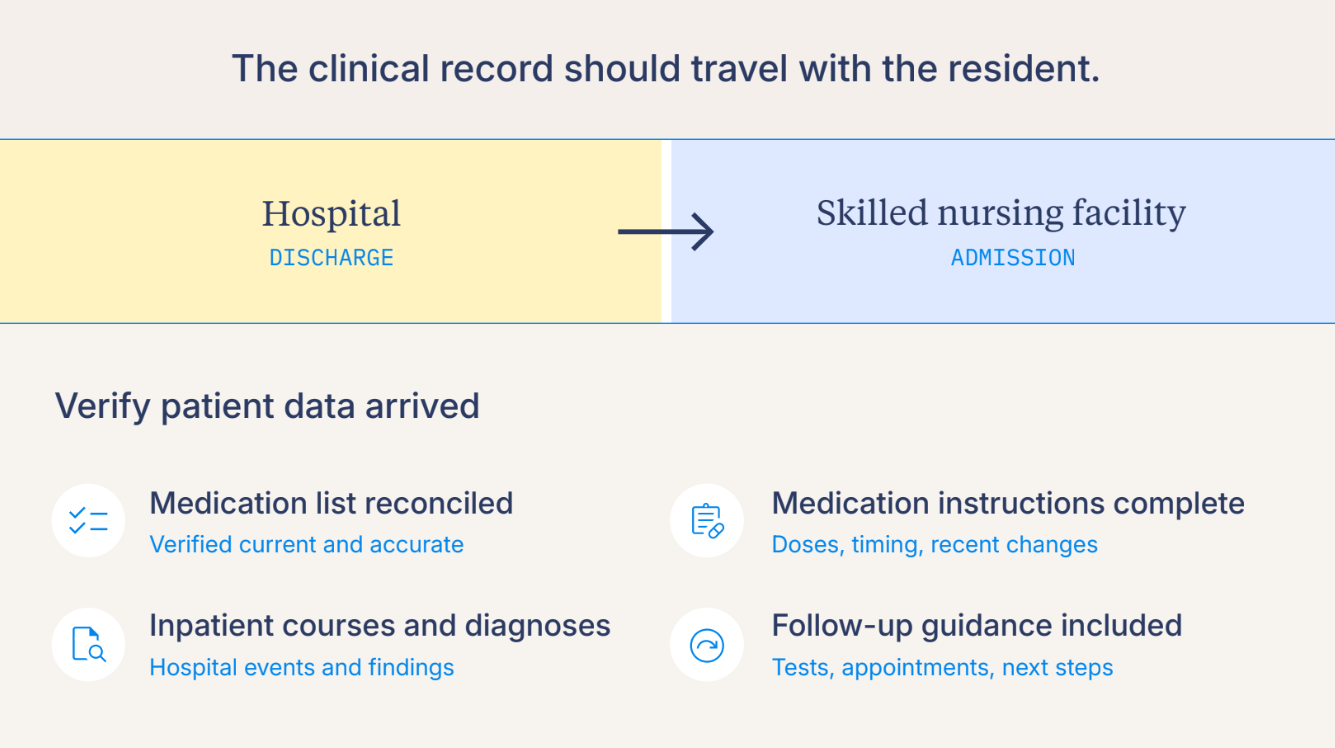
A new resident arrives, but the complete clinical picture does not always travel with them. This is one of the quieter operational considerations of working across settings. A handoff from a hospital does not guarantee that medication details, the inpatient course, and follow-up guidance arrive complete and ready to use.
A case study in the Journal of Brown Hospital Medicine documented how often these issues recur at hospital-to-SNF transitions. When information has to be rebuilt after admission, the cost lands on operations first and care second.
Staff spend time reconstructing information that should have arrived with the resident.
The operational answer is not to expect every handoff to be flawless. It is to build intake workflows that capture a complete picture quickly, so the work of care can begin without delay.
Confirming the hospital-to-SNF handoff
Reliable systems free teams to focus on care
Variability is rarely solved by working harder. The most resilient facilities write down how care is delivered, so that knowledge does not leave with any one person.
Documented protocols, structured onboarding, and a single source of truth let a new team member step into a stable system and perform well sooner. Documentation built into the workflow, rather than bolted on afterward, keeps everyone aligned without adding steps to a full day.
Operators are already moving this way. Austin Steele, chief strategy officer at Indiana operator Journey, said his organization has invested in "our operational infrastructure, our culture, our clinical quality," and is now turning that work toward innovation.
The timing matters. SNN's Executive Outlook points to reimbursement aligning more closely with the care actually delivered in SNFs. That shift rewards facilities with consistent workflows behind the care.
A regulatory floor that keeps moving
Requirements rarely sit still. In December 2025, CMS repealed the federal minimum staffing standards for long-term care facilities, with a moratorium that runs through September 30, 2034. The result is more local judgment, not less responsibility.
The measurement bar is rising too. Beginning in fiscal year 2027, the SNF Value-Based Purchasing program expands from four quality measures to eight. More of what happens inside a facility will be measured, and more of it will be tied to payment.
Administrators now justify staffing decisions through their own facility assessments, while keeping pace with evolving quality measures on functional outcomes and the transfer of health information. Predictability is no longer something a federal floor guarantees. It is something each facility builds for itself.
This is where durable processes earn their value. A facility that has written down how care is delivered stays ready for the next measure, whatever shape it takes. Compliance becomes the result of sound daily practice rather than a separate, recurring scramble.
Closing thoughts for Q3
Consistency depends on visibility. When a facility's clinical and operational signals sit in one clear view, variability becomes easier to manage, and predictable operations become the foundation for steadier, more continuous care. That is the role Lumina360 is built to play: a clinical dashboard that allows administrators, clinical leads, and operators to see facility KPIs and patient data in one place.
Operational trust is earned through consistency.
Upcoming events:
Florida Health Care Association Annual Conference
July 26 – 30
Zimmet
August 8 – 13
Texas Health Care Association Annual Conference
September 22 – 25