

Lumina Care Quarterly: Exploring a more stable approach to care delivery
Welcome to Lumina Care’s inaugural quarterly newsletter.
Each quarter, we’ll examine a fundamental question facing post-acute, long-term, and community-based care. This quarter, we explore the question: Why does care stabilize in some environments, while in others it repeatedly escalates?
As a preview of what’s to come, this quarter’s anchor is simple:
When care isn’t visible, it escalates. When it is, it stabilizes.
What this means for care delivery.
More often than not, escalations happen because of fragmentation in some form or another. Responsibilities are unclear, or critical context is missing at the moment decisions are made.
Across care settings, we’ve seen similar patterns repeat:
- Information is strewn across many places.
- Teams work in parallel instead of in sync.
- Continuity breaks down between shifts, specialties, or settings.
The Decision-Makers Checklist:
- Do we all know where patient records are?
- Are patient records up-to-date and easy-to-access?
- Where are delays in communication happening?
In this issue, we explore what happens when visibility—and integration—improves. Not through more tools or shiny new SaaS. Rather, through better coordination and communication, consistently applied across care teams.
The Solution to Fragmentation in Care Delivery
In complex care settings, interdisciplinary teams consistently emerge as one of the most effective ways to reduce fragmentation.
The following example shows how this works in practice: a complex prescribing challenge addressed through regular coordination with effective and repeatable outcomes.
Welcome to Ontario
Study: https://www.jamda.com/article/S1525-8610(24)00749-7/fulltext
In Ontario, Canada, a significant effort was made to address the fact that almost half of adults were receiving inappropriate medications. Within a single organization’s long-term care (LTC) facilities, an interdisciplinary team was assembled to reduce the overuse and misuse of antipsychotics (APs).
NB: The Federal Drug Administration’s regulations differ from Canada’s governing bodies. This study is intended to show the results achievable with team-based care coordination among a complex care cohort with a high prevalence of behavioral health needs. The specific interventions in this study may not be adequate for US providers.
How It Happened
Rather than focusing on individual prescribing decisions, the initiative addressed the systems around them.
Leaders introduced a structured approach designed to improve visibility, shared accountability, and clinical follow-through across facilities.
What Changed
An interdisciplinary team was formed, bringing together:
- Six nurse specialists
- A physician assistant
- An advanced practice nurse practitioner (behavioral support expertise)
- A clinical pharmacist
- A senior physician
Their role was to create consistency:
- Educate facilities and support local teams
- Standardize assessments and chart reviews
- Document recommendations clearly within PointClickCare
- Present evidence-based guidance to attending clinicians, who retained final decision-making authority
What Happened Next
85% of facilities reduced inappropriate use of APs.
Overall rates of AP use dropped by 40.6%, from 21.0% to 12.2% across 34 LTC facilities.
Diagnosis rates did not change.
From the study: “Once these meetings were consistently implemented, the intrinsic motivation derived from the process of deprescribing, combined with the observed outcomes… proved sufficient to sustain the QI deprescribing initiative over the long term.”
The Takeaway
When care decisions became more accessible and routinely revisited, practices changed.
From the study:
“Front-line staff were proud to have made a positive difference in the lives of residents and their caregivers.”
Reflection: Visibility Improves Care Thoughts
Care may escalate in a single moment, but it rarely does so because of a single decision. More often, escalations occur when teams lack visibility to act early, continuity to follow through, or confidence that the system will support sound judgment.
Better visibility leads to better decisions.
Durable care delivery—especially for complex patient populations—depends on clearer signals, shared accountability, and reliable coordination, shift after shift.
Look Out for Lumina Care
Dr Glen Rebman, Director of Telepsychiatry, will appear on Becker’s Healthcare Behavioral Health Podcast.
https://www.beckerspodcasts.com/behavioral-health
Conferences We’re Attending This Quarter
February 9 – 11
Miami, FL
Feb 23 – 25
San Antonio, TX
March 4 – 6
Orlando, FO
Session Spotlight: SNN Behavioral Health Panel
New Feature: Lumina360

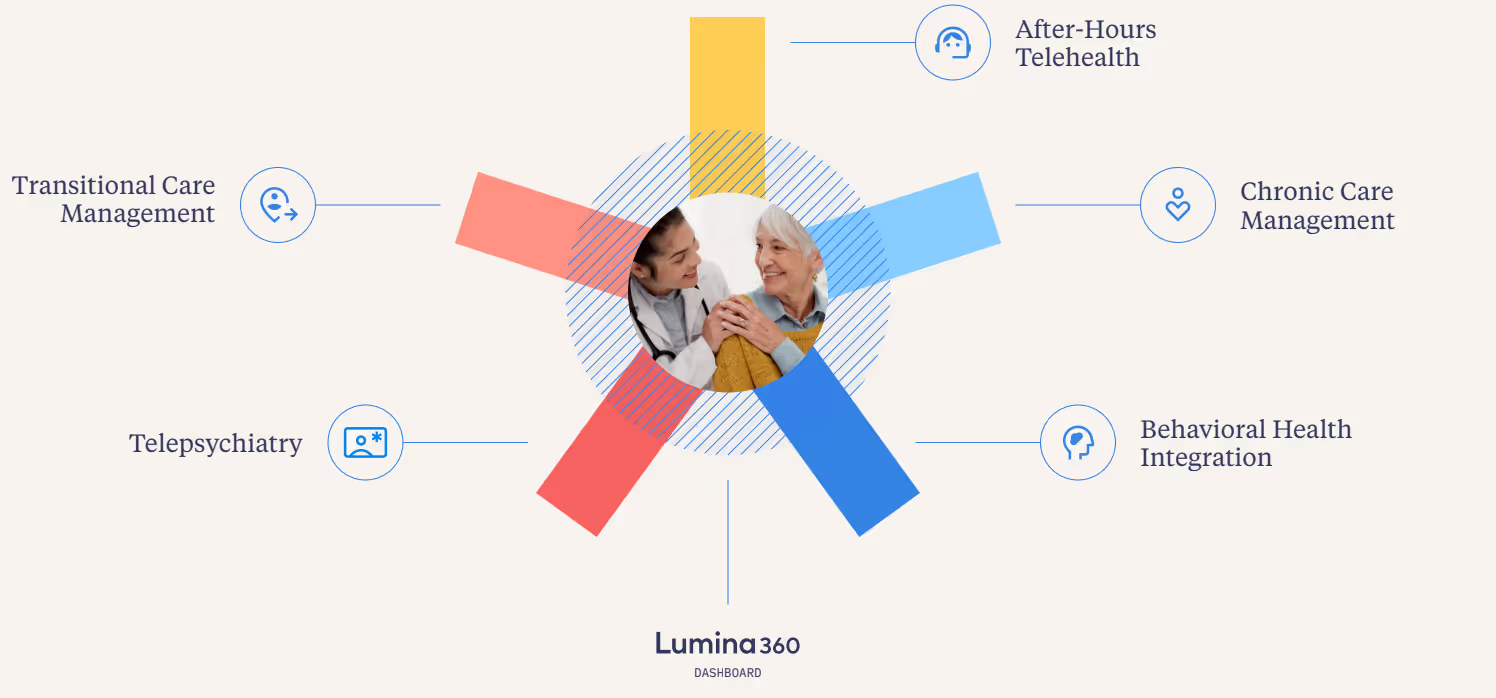
Lumina360 is a powerful dashboard that integrates with PointClickCare and other electronic health records (EHRs) to provide better visibility into care delivery. Track trends, compliance, and help providers identify individual patient needs in just a few clicks.
Our goal with Lumina360 is to enable earlier interventions that stabilize care in skilled nursing and complex care populations. With access to essential care insights, teams can intervene earlier and stay abreast of compliance requirements.
Learn more at luminacare.com/360
Lumina Care’s Active Approach to Preventive Care
We integrate with your care team to provide augmented, coordinated care delivery. Across settings, disciplines, and hours of the day, we help your organization improve care outcomes with a proactive approach.
Results with Lumina Care:
- Fewer escalations
- Reduced rehospitalizations in skilled nursing care
- Improved care outcomes
Our Services:
Learn More: LuminaCare.com
Continue the Conversation
In future issues, we’ll continue to explore how care breaks down or improves with continuous execution, operational trust, and identifying the truth that preventative care is a system, not a tactic.
CTA: Sign up for our newsletter
Follow us on LinkedIn, where we explore care delivery, quality, and consistency across care settings, systems, and specialties.